
Dental SEO Keywords: The Best Keywords Dentists Should Target to Rank in Google
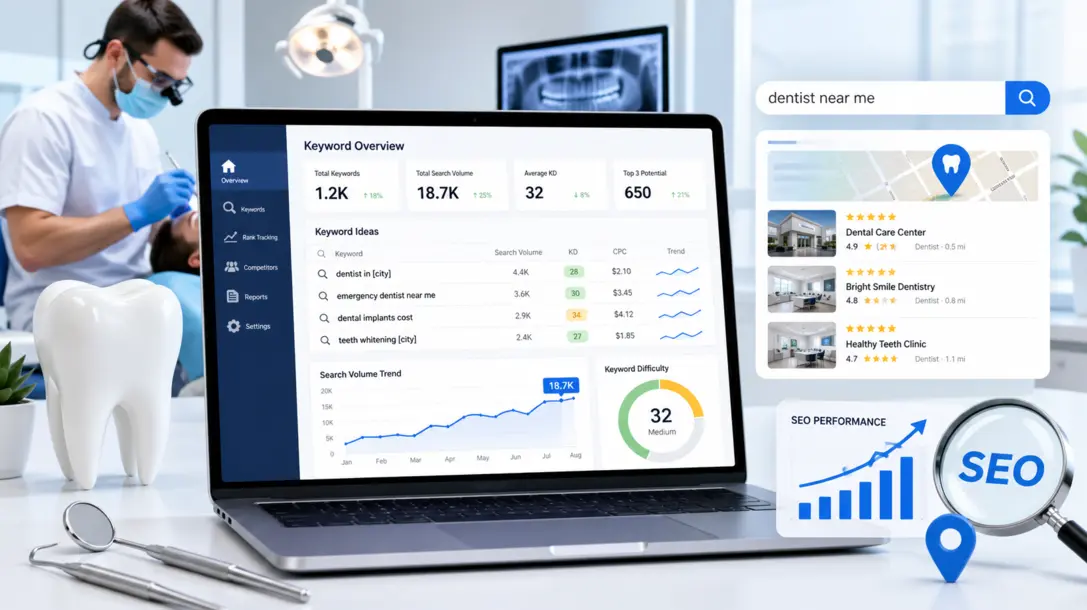
Dental SEO Keywords are the words and phrases that dental practices target so their website can appear in Google when patients search for nearby dental care, specific treatments, or answers to dental questions. These keywords may be broad, like dentist in [city], or highly specific, like how much do dental implants cost in [city] or emergency dentist near [neighborhood].
If a dentist wants more organic traffic from Google, the website has to be built around the right keywords. That does not mean stuffing the same phrase everywhere. It means understanding what patients are actually searching for, grouping those searches by intent, and assigning the right keyword groups to the right pages.
This is one of the core building blocks of dental SEO. A practice might offer excellent care, but if the website does not target the phrases people actually use, Google has less reason to connect the practice to those searches. That is why Dental SEO Keywords matter so much. They define what the website is trying to rank for.
For the broader strategy behind local dental search, service pages, Google Business Profile, reviews, and content structure, see our full SEO For Dentists guide. This page focuses specifically on the keyword side of that strategy.
Why Dental SEO Keywords Matter So Much
Keywords matter because they connect what a dental practice offers with what patients search for. Google does not rank pages in a vacuum. It tries to match search intent with the most relevant pages and businesses. If a practice wants to rank for cleanings, veneers, implants, emergency care, or family dental services, the site needs pages that clearly reflect those topics.
The right Dental SEO Keywords also help organize the entire website. They determine what belongs on the homepage, what should become a service page, what should become a nearby-city page, and what should be turned into blog content. Without that structure, many dental websites become too broad and end up ranking weakly for everything.
Good keyword targeting helps dentists:
- Show up for high-intent local searches.
- Rank for specific treatments, not just the practice name.
- Expand visibility into nearby cities and neighborhoods.
- Capture patient questions earlier in the decision cycle.
- Build a more organized and scalable content strategy.
In other words, Dental SEO Keywords are not just a list of phrases. They are the framework that shapes the entire local search strategy of the website.
| Keyword Type | What It Does | Example |
|---|---|---|
| General local keyword | Targets the main practice search | dentist in Fort Worth |
| Service keyword | Targets a specific treatment | dental implants in Fort Worth |
| Location keyword | Targets nearby service areas | dentist near Keller |
| Informational keyword | Targets patient questions | how much does Invisalign cost in Fort Worth |
The Main Types of Dental SEO Keywords
The easiest way to understand Dental SEO Keywords is to split them into intent-based categories. Each category usually belongs on a different kind of page.
1. General practice keywords
These are broad local phrases people use when they are looking for a dentist in general. They usually belong on the homepage or core practice pages.
- dentist in [city]
- dental office [city]
- family dentist [city]
- cosmetic dentist [city]
- pediatric dentist [city]
2. Service keywords
These target specific treatments or service categories. They usually belong on dedicated service pages.
- dental implants [city]
- Invisalign [city]
- teeth whitening [city]
- veneers [city]
- root canal [city]
- dentures [city]
- tooth extraction [city]
3. Emergency and urgent keywords
These are high-intent phrases from people who may need help quickly. They often deserve their own focused service page.
- emergency dentist [city]
- same day dentist [city]
- tooth pain dentist [city]
- broken tooth dentist [city]
- weekend dentist [city]
4. Location and nearby-city keywords
These help the practice appear in cities and neighborhoods around the main office location.
- dentist near [town]
- family dentist near [city]
- cosmetic dentist near [city]
- emergency dentist near [city]
5. Informational keywords
These capture patient questions and research intent. They usually belong on blog posts or educational pages.
- how much do dental implants cost in [city]
- what happens during a root canal
- is teeth whitening safe
- how long do veneers last
- what to do if you crack a tooth
When Dental SEO Keywords are grouped this way, it becomes much easier to build a logical site structure and avoid sending every keyword to the same page.
Best Dental SEO Keywords Dentists Should Consider
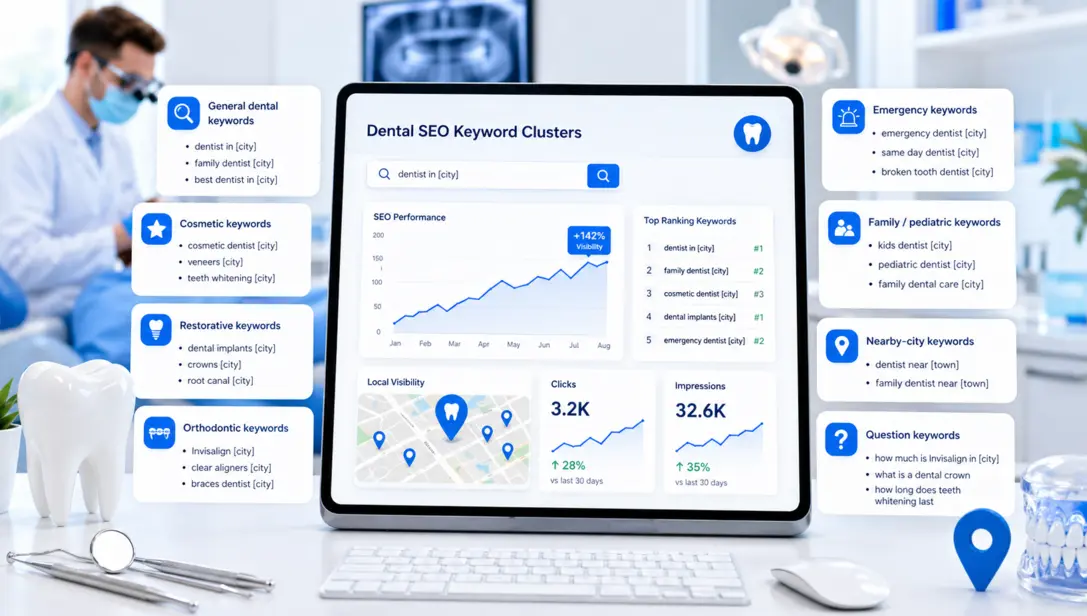
The exact keyword list will vary by practice, specialty, and geography, but below is a strong set of Dental SEO Keywords that many dental offices should consider.
| Keyword Group | Example Keywords |
|---|---|
| General dental keywords | dentist in [city], dental office [city], family dentist [city], best dentist in [city] |
| Cosmetic keywords | cosmetic dentist [city], veneers [city], teeth whitening [city], smile makeover [city] |
| Restorative keywords | dental implants [city], dentures [city], crowns [city], bridges [city], root canal [city] |
| Orthodontic keywords | Invisalign [city], clear aligners [city], braces dentist [city] |
| Urgent care keywords | emergency dentist [city], same day dentist [city], tooth pain dentist [city], broken tooth dentist [city] |
| Family and pediatric keywords | kids dentist [city], pediatric dentist [city], family dental care [city] |
| Nearby-city keywords | dentist near [town], family dentist near [town], cosmetic dentist near [town] |
| Question keywords | how much is Invisalign in [city], how long do veneers last, what is a dental crown |
Example high-value Dental SEO Keywords list
- Dental SEO Keywords
- dentist in [city]
- family dentist in [city]
- cosmetic dentist in [city]
- pediatric dentist in [city]
- emergency dentist in [city]
- dental implants in [city]
- Invisalign in [city]
- teeth whitening in [city]
- veneers in [city]
- root canal in [city]
- dentures in [city]
- tooth extraction in [city]
- wisdom teeth removal in [city]
- sedation dentistry in [city]
- best dentist in [city]
- top rated dentist near me
- dentist near [neighborhood]
- affordable dentist in [city]
- dental office accepting new patients in [city]
- same day dentist in [city]
- how much do dental implants cost in [city]
- how much is Invisalign in [city]
- what to do if you chip a tooth
- how often should kids go to the dentist
- does insurance cover dental implants
- what happens during a root canal
- how long does teeth whitening last
The most important thing is not to force all of these onto one page. Each keyword cluster should be assigned to the page type that best matches the search intent.
How To Map Dental SEO Keywords to the Right Pages
Keyword mapping means deciding which keyword group belongs to which page. This is one of the most important parts of using Dental SEO Keywords correctly. Without mapping, sites often create overlap, where multiple pages compete for the same term or the homepage tries to rank for everything.
A good keyword map usually looks like this:
| Page Type | Best Keyword Type | Example |
|---|---|---|
| Homepage | Broad local practice keywords | dentist in Fort Worth |
| Service page | Treatment keywords | dental implants in Fort Worth |
| Location page | Nearby-city keywords | dentist near Keller |
| Blog article | Question, cost, and comparison keywords | how much does Invisalign cost in Fort Worth |
This structure helps Google understand what each page is meant to rank for. It also makes internal linking easier, because informational pages can naturally link to service and location pages.
Which Dental SEO Keywords Belong on the Homepage
The homepage should usually target the broadest and most important local keyword cluster for the practice. In most cases, that means phrases like:
- dentist in [city]
- dental office [city]
- family dentist [city]
- cosmetic dentist [city]
The homepage is usually not the best place to target every treatment and every nearby city. Instead, it should establish the main identity of the practice and the primary service area.
For example, if a dental office is based in Fort Worth, the homepage may focus on dentist in Fort Worth while linking to internal pages for implants, Invisalign, emergency care, and nearby areas like Keller or Bedford.
This approach keeps the homepage focused and prevents it from becoming overloaded with too many competing Dental SEO Keywords.
Which Keywords Belong on Dental Service Pages
Service pages should target treatment-specific Dental SEO Keywords. These are some of the highest-value keyword groups because they often reflect stronger intent.
Examples include:
- dental implants in [city]
- Invisalign in [city]
- teeth whitening in [city]
- veneers in [city]
- root canal in [city]
- emergency dentist in [city]
- sedation dentistry in [city]
- dentures in [city]
Each service page should focus on one main keyword cluster and related variations, not multiple unrelated treatments. A page about veneers should not also try to rank for implants, root canals, and whitening all at once. That weakens topical focus.
Strong service pages are one of the biggest assets in dental SEO because they let the site match treatment intent directly.
How Dentists Should Use Location Keywords
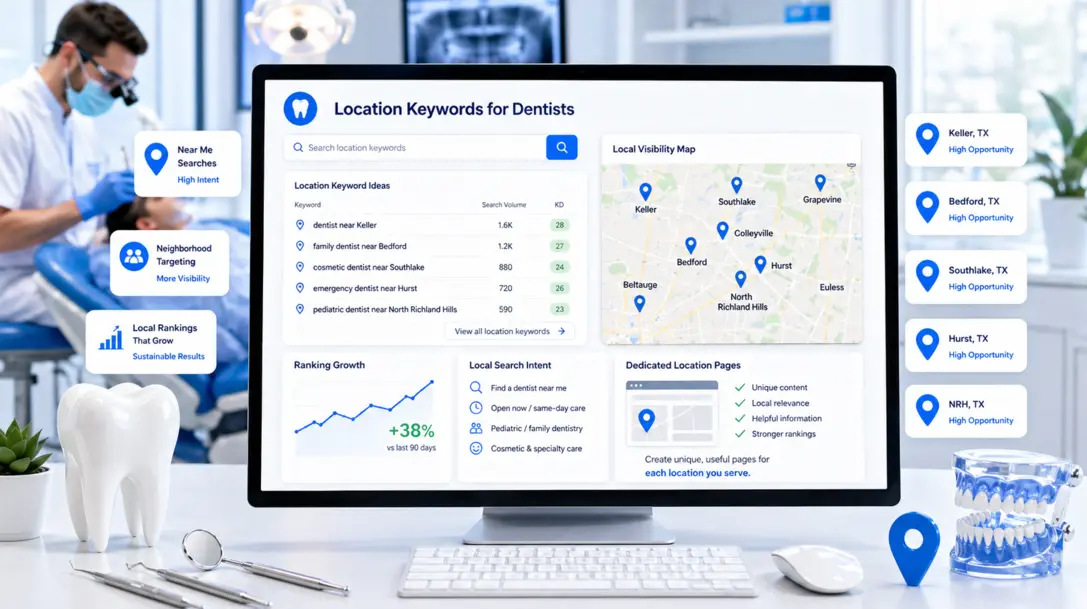
Location keywords help a practice rank in nearby cities, suburbs, and neighborhoods beyond the main office city. These are extremely useful when a dentist gets patients from several surrounding areas.
Examples include:
- dentist near Keller
- family dentist near Bedford
- cosmetic dentist near Southlake
- emergency dentist near Hurst
- pediatric dentist near North Richland Hills
These keywords usually belong on dedicated location pages, not stuffed into the homepage. Each location page should feel unique and useful to patients in that area.
Location-based Dental SEO Keywords are especially valuable in metro areas where patients regularly cross city lines for care.
Blog and Informational Dental SEO Keywords
Blog and educational content should target informational Dental SEO Keywords. These are the kinds of searches people make when they are researching treatment options, trying to understand symptoms, or comparing solutions before choosing a provider.
Good examples include:
- how much do dental implants cost in [city]
- what happens during a root canal
- how long does teeth whitening last
- does Invisalign hurt
- what to do if you break a tooth
- how often should kids see a dentist
- veneers vs crowns
- does insurance cover dental implants
These keywords are valuable because they expand the site’s topical authority and create internal linking opportunities to treatment pages. A cost article can link to the implants page. A symptom article can link to the emergency dentistry page. A comparison article can link to relevant cosmetic pages.
This is where content strategy starts to compound. Educational pages support the entire SEO structure, especially when they are built around the right keyword clusters.
Common Dental Keyword Mistakes To Avoid
Even when dentists know they need Dental SEO Keywords, they often use them in ways that weaken the site. Common mistakes include:
- Trying to target too many unrelated keywords on one page.
- Sending every major keyword to the homepage.
- Creating multiple pages that compete for the same term.
- Ignoring nearby-city keywords even when those patients are important.
- Publishing thin service pages with almost no depth.
- Writing blog content that does not support business goals.
- Keyword stuffing instead of writing naturally.
The goal is not to repeat keywords as much as possible. The goal is to give each important keyword cluster a strong, relevant home.
How BlogBuster Helps Dentists Use Dental SEO Keywords at Scale
Most dental practices do not have trouble understanding that keywords matter. The real challenge is execution. It takes time to research keyword groups, map them to pages, and then actually publish enough content to cover those clusters properly. That is where BlogBuster can help.
BlogBuster can help dentists create content around Dental SEO Keywords at scale, including:
- Homepage-supporting local content
- Treatment pages for major services
- Nearby-city pages for surrounding markets
- Informational articles around patient questions
- Cost and comparison content for high-value procedures
That means a dentist can build out keyword coverage across services and locations instead of relying on a small brochure-style site. BlogBuster helps make that content operation much more scalable.
Frequently Asked Questions
What are Dental SEO Keywords?
Dental SEO Keywords are the words and phrases dentists target so their website can rank in Google for local dental searches, treatment searches, and patient questions.
What are the best keywords for dentists?
The best keywords usually include general practice terms, service keywords, nearby-city keywords, and informational terms. Examples include dentist in [city], emergency dentist [city], dental implants [city], and Invisalign cost in [city].
Should dentists target nearby cities?
Yes, if they truly serve those areas. Nearby-city keywords can help expand local visibility beyond the main office city.
Should every keyword go on the homepage?
No. Broad local terms usually belong on the homepage, while treatment keywords belong on service pages, nearby-city terms belong on location pages, and question keywords belong on blog content.
How do Dental SEO Keywords support SEO For Dentists?
Dental SEO Keywords help shape the structure of the site and make it easier for Google to match the right pages to the right searches. They are one of the core foundations of a broader SEO For Dentists strategy.