
Why SEO Is the Highest ROI Marketing Channel
Explore data-backed reasons why an organic strategy provides superior returns over paid advertising and social platforms. Learn to build a durable digital asset for sustainable business growth.
Building a Foundation for Sustainable Digital Growth
Every marketing leader faces the same challenge: where to allocate your budget for the best long-term results. With organic search driving 53% of all website traffic, the data points to a clear starting line. Yet, many still view it as just another traffic source. It’s time to reframe that thinking. Organic search is not a tactic you deploy, but a strategic investment in a permanent digital asset.
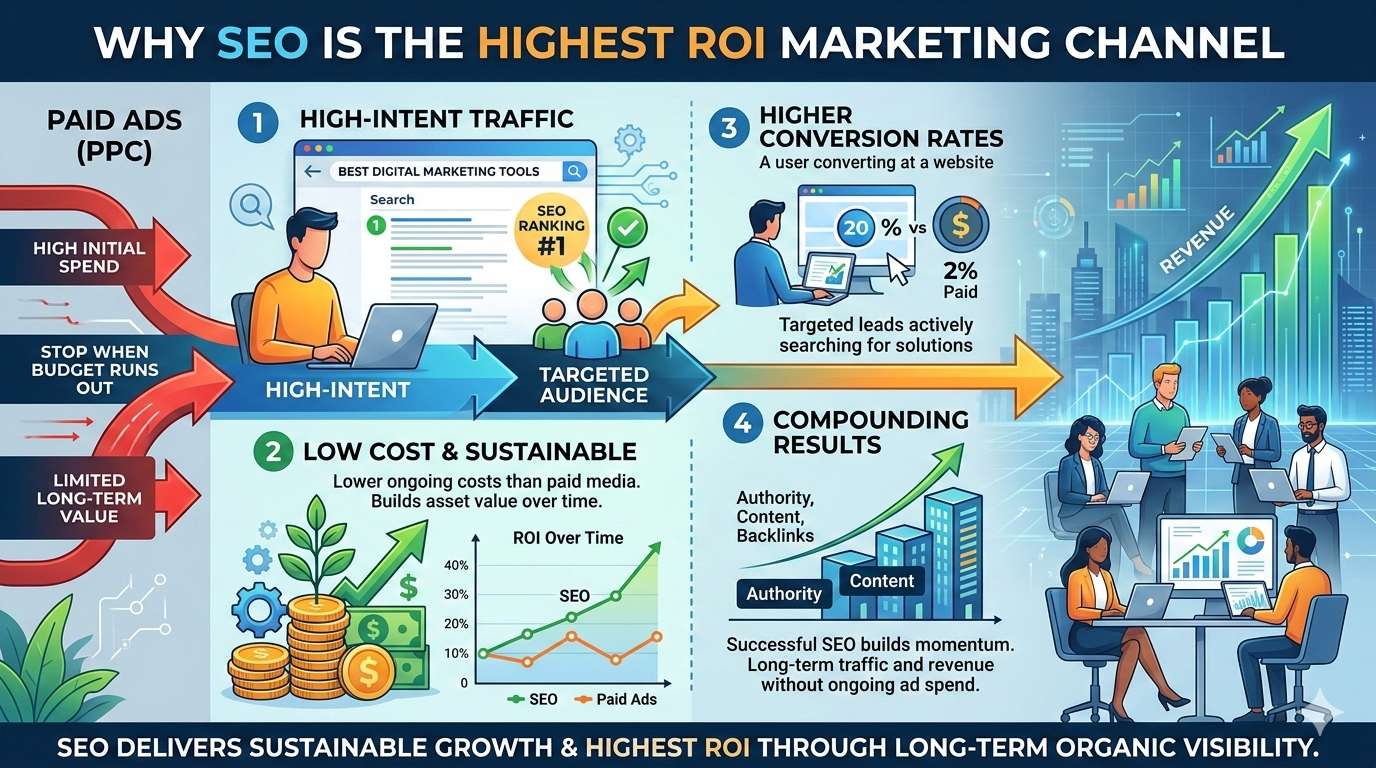
Unlike a paid ad that vanishes the moment you stop paying, the content and authority you build through organic search continue to generate returns indefinitely. Think of it as the difference between renting an apartment and owning a home. Renting gives you temporary shelter, but every payment disappears. Owning builds equity, an asset that appreciates and provides security over time. This is the fundamental reason why invest in SEO is a conversation about building lasting business value, not just short-term visibility.
By focusing on organic growth, you are constructing a digital presence that belongs entirely to you. Each piece of content, every technical improvement, and each backlink earned becomes a brick in a foundation that supports all your other marketing efforts. This approach shifts your entire digital strategy from chasing fleeting attention to creating a durable, reliable engine for customer acquisition.
A Cost-Benefit Analysis Against Paid Advertising
When you place organic search and paid advertising side by side, the financial models tell two very different stories. Paid search, or PPC, operates on a perpetual expenditure model. You pay for every click or impression, and your visibility is directly tied to your daily budget. The moment that budget runs out, you disappear. Organic search, in contrast, requires a front-loaded investment in content, technical optimization, and authority building. Funding this initial strategic work is a common challenge, and many businesses explore options like small business loans for cash flow to ensure they can build their digital asset without disrupting operations.
While the initial outlay for organic search may seem significant, the Cost-Per-Acquisition (CPA) behaves in a completely different way. With PPC, your CPA often remains static or even increases as competition for keywords drives up bid prices. With organic search, your CPA steadily decreases over time. The initial investment continues to pay dividends for months and years, attracting traffic and leads without additional cost per click. This creates a powerful financial advantage. Analyses from industry sources like Terakeet show that organic search can drive five times more traffic than paid campaigns, fundamentally changing the scale of your reach.
The debate over SEO vs paid ads ROI ultimately comes down to asset creation. Paid ads offer predictable, immediate traffic but build no lasting value. Organic search builds an asset that appreciates, creating a sustainable and increasingly cost-effective channel for growth.
| Metric | Organic Search (SEO) | Paid Advertising (PPC) |
|---|---|---|
| Cost Model | Front-loaded investment (content, technical) | Perpetual, pay-per-click/impression |
| Cost-Per-Acquisition (CPA) | Decreases over time as asset builds | Static or increases with competition |
| Long-Term Value | Asset appreciates and compounds | No residual value once budget stops |
| Traffic Potential | High, captures majority of user clicks | Limited by daily/monthly budget |
| Audience Trust | Higher, seen as more authentic | Lower, often perceived as intrusive |
This table contrasts the core financial and strategic differences between investing in organic search versus paid advertising. The data illustrates how organic search builds a more sustainable and cost-effective asset over the long term.
Prioritizing Qualified Leads Over Social Engagement
The comparison with social media shifts the conversation from cost to quality. While social platforms are excellent for building brand awareness and engaging with your community, their effectiveness for direct lead generation pales in comparison to search. The reason is simple: user intent. A person scrolling through their social feed is typically in a passive state of discovery, not actively looking for a solution. They are there to be entertained or connect with friends, not to make a purchase decision.
Contrast that with someone typing a query into a search engine. That user has an active need. They are looking for an answer, a product, or a service right now. This proactive mindset places them much further down the buying funnel, making them a significantly more qualified lead. According to a 2025 report from SimpleTiger, a significant 60% of B2B marketers confirmed that organic search produced more qualified leads than any other marketing channel. This is the power of effective organic search lead generation.
Attracting these qualified leads depends on creating content that directly answers their questions, which is how quality content builds lasting SEO authority and trust with your audience. While a viral social media post might generate thousands of likes, it rarely translates into meaningful business opportunities. An optimized blog post that solves a specific customer problem, however, will consistently attract high-intent individuals ready to take the next step.
How Your Organic Visibility Compounds Over Time
The most powerful financial argument for organic search is a concept that paid channels simply cannot replicate: compounding value. Think of your organic presence as a high-yield investment account. Each piece of high-quality content you publish is like a deposit that not only retains its value but also earns interest over time. A single, well-researched article can continue to attract traffic, generate leads, and build your site’s authority for years after it’s published.
This is the true long term value of SEO. As your content earns backlinks from other reputable sites and demonstrates its relevance to search engines, its visibility often increases. An article that ranked on the second page a year ago might climb to the top three positions, exponentially increasing its traffic without any additional investment from you. This compounding effect is fueled by consistency, which is why a steady blog is your key to more organic traffic and sustained growth over time.
Contrast this with the fleeting nature of other marketing activities:
- A Paid Ad: Its value is immediate but disappears the second the budget is cut. There is no residual impact.
- A Social Media Post: It has a lifespan of a few hours before it is buried in the feed, providing a brief spike in engagement but no lasting presence.
- An Organic Asset (e.g., a blog post): Its value grows over months and years, creating a durable competitive moat that becomes increasingly difficult and expensive for competitors to overcome.
This compounding growth transforms your website from a simple brochure into a powerful, self-sustaining business development machine.
Proving the Financial Return to Your Stakeholders
Making the case for a long-term investment requires speaking the language of business outcomes. To justify your organic search strategy to leadership, you must move the conversation beyond vanity metrics like clicks and impressions. Your stakeholders want to see a clear connection between your efforts and the bottom line. The key is to calculate SEO return on investment with data that matters.
Start by tracking conversions that directly contribute to revenue. This means focusing on metrics like lead form submissions, demo requests, free trial sign-ups, and e-commerce sales originating from organic traffic. By assigning a monetary value to each of these conversions, you can build a clear equation that pits revenue generated against the cost of your investment.
To present a compelling case, follow these steps:
- Track Conversions: Use analytics to attribute leads and sales directly to organic search traffic.
- Assign Lead Value: Work with your sales team to determine the average value of a lead from each channel.
- Calculate Total Value: Multiply the number of organic conversions by their average value to determine the total revenue generated.
- Compare to Cost: Subtract the total cost of your organic search investment (including content, tools, and personnel) from the total value generated.
For forecasting future returns, you can use established frameworks like Forrester's Total Economic Impact (TEI) model to project long-term value. As Kavi Kardos of Moz emphasizes, the most powerful arguments connect SEO metrics directly to revenue-generating actions, moving the conversation from clicks to conversions.
Navigating the Realities of a Long-Term Strategy
While the financial case is compelling, it is important to approach organic search with realistic expectations. This is not a quick fix. Building a strong organic presence is a marathon, not a sprint, and you should expect significant returns to materialize over six months or more. This long-term commitment is precisely what makes it such a defensible strategy.
You will face challenges along the way. Search engine algorithms are constantly being refined, which can cause temporary fluctuations in rankings. However, a resilient strategy does not chase algorithms. Instead, it focuses on what never changes: creating a great user experience and understanding how to use an AI article writer to publish high-quality, genuinely helpful content at scale. You must also be mindful of "technical debt," the gradual decay of your site’s technical health. Continuous maintenance to ensure your site remains fast, secure, and mobile-friendly is non-negotiable.
These challenges are not reasons to avoid organic search. They are the barriers to entry that, once overcome, protect your investment from competitors who lack the patience or foresight to see it through. Despite the upfront effort and the need for persistence, the data and financial models consistently show that organic search remains the highest ROI marketing channel for businesses dedicated to building sustainable, long-term growth.